
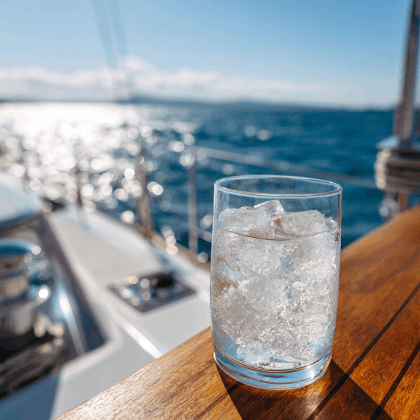
When you're out at sea or traveling to remote locations, understanding what's in your drinking water matters. Watermakers have become essential equipment for sailors, yacht owners, and marine enthusiasts who need reliable access to fresh water. The question of what minerals remain after the reverse osmosis process is important for anyone considering or already using these systems.
This article explores the mineral composition of water produced by reverse osmosis watermakers, how the desalination process affects mineral content, what trace elements typically remain, and how this impacts water quality for daily consumption. We'll also look at the health considerations of drinking low-mineral water over extended periods.
Reverse osmosis technology works by forcing seawater through semi-permeable membranes under high pressure. These membranes have incredibly small pores that block most dissolved solids, including salts and minerals. The process is highly effective at removing sodium, chloride, magnesium, calcium, and other minerals commonly found in seawater. This is exactly what makes watermakers so valuable for converting saltwater into drinking water.
The efficiency of reverse osmosis means that most minerals don't make it through the membrane. Typically, a quality watermaker removes 95-99% of dissolved solids from the source water. This high rejection rate is necessary to transform seawater, which contains roughly 35,000 parts per million of dissolved solids, into water safe for human consumption.
However, the process isn't absolutely perfect, which is actually beneficial. Some minerals do pass through the membranes in very small amounts. The exact amount depends on factors like membrane condition, operating pressure, water temperature, and the quality of the source water being processed.
Even after thorough reverse osmosis filtration, watermaker-produced water isn't completely devoid of minerals. Small amounts of certain elements can pass through the membrane, particularly those with smaller molecular sizes. Sodium is one mineral that appears in trace amounts, though at levels far below seawater concentrations. Some calcium and magnesium ions may also remain in very minimal quantities.
The total dissolved solids (TDS) level in water from a marine desalination system typically ranges from 200 to 500 parts per million, compared to seawater's 35,000 ppm. This represents a dramatic reduction, but it's not zero. The remaining minerals contribute to the water's taste and can provide small nutritional benefits, even if they're not significant sources of daily mineral intake.
Boron is another element that can partially pass through reverse osmosis membranes due to its molecular characteristics. While present in tiny amounts, it doesn't pose health concerns at the concentrations found in properly functioning watermaker output. The specific mineral profile varies slightly based on the source water composition and system specifications.
The water produced by reverse osmosis systems meets or exceeds most international drinking water standards. Organizations like the World Health Organization and various national agencies set guidelines for acceptable levels of dissolved solids and specific minerals in drinking water. Marine watermakers are designed to produce water that falls comfortably within these safety parameters.
Total dissolved solids levels between 300 and 500 ppm are generally considered excellent for drinking water. This range provides enough mineral content to give water a pleasant taste while ensuring purity. Water that's too low in minerals can taste flat or slightly acidic, while the trace minerals remaining in watermaker-produced water help maintain better flavor characteristics.
Most quality desalination systems include post-treatment options that can add specific minerals back into the water if desired. These remineralization filters can reintroduce calcium, magnesium, and other beneficial minerals in controlled amounts. This allows users to customize their water's mineral profile based on personal preferences or nutritional goals.
Drinking water with reduced mineral content over long periods has been studied extensively. The human body primarily obtains minerals from food rather than water, so drinking low-mineral water doesn't typically cause nutritional deficiencies. Your diet remains the main source of essential minerals like calcium, magnesium, potassium, and trace elements.
Some people prefer water with higher mineral content because of taste preferences or the belief that it offers health benefits. While minerals in water can contribute to daily intake, the amounts are generally small compared to what's available from a balanced diet. A varied diet with vegetables, fruits, whole grains, and proteins provides far more minerals than any drinking water source.
The minerals that do remain in watermaker-produced water still contribute to its characteristics. The trace amounts of calcium and magnesium, for example, affect water's pH level and can help prevent the slightly acidic taste sometimes associated with completely demineralized water. This makes the water more palatable for regular consumption during extended voyages.
Water produced by reverse osmosis watermakers contains trace amounts of various minerals, typically resulting in total dissolved solids levels between 200 and 500 parts per million. While these systems remove 95-99% of minerals from seawater, small quantities of elements like sodium, calcium, magnesium, and boron pass through the membranes. This creates water that's pure enough to be safe and pleasant to drink while retaining enough mineral content to maintain good taste characteristics.
If you're considering a marine watermaker for your vessel, our systems combine advanced reverse osmosis technology with energy-efficient design to produce high-quality drinking water wherever your journey takes you. Get a free quote for a marine watermaker today and discover how easy it is to achieve water independence at sea.

Darryl Massey is a seasoned expert in reverse osmosis watermaker technology, with a keen focus on sustainable solutions. With over two decades at EcoSistems, Darryl combines deep technical knowledge and a commitment to innovation, contributing to the development of energy-efficient systems. His expertise ensures advanced, reliable solutions in water purification for clients across the globe.
WATERMAKERS
Sailboat Watermarker
Yacht Watermarker
Boat Watermarker
Reverse Osmosis Watermarker
Watermarker Machine
Marine Watermarker
DESALINATION
Sea water dasalination device
Desalination plant
Reverse osmosis desalination system
Reverse osmosis desalination machine
Reverse osmosis filter
Desalination machine for boat
Reverse osmosis desalination for boats
Desalination machine for sail boat
Desalination machine for yacht
