
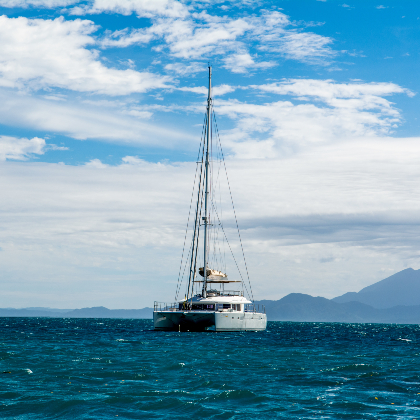
Catamarans have become one of the most popular choices for bluewater cruising, and it's easy to see why. Their stability, space, and comfort make them a natural home for the kind of long-range, self-sufficient sailing that many sailors dream of.
One of the biggest shifts that comes with liveaboard or offshore catamaran sailing is rethinking how you manage fresh water. This article covers the space advantages catamarans offer for watermaker installation, how their power systems support the technology, why catamaran crews tend to use more water, and how the twin-hull layout makes the whole setup more practical.
One of the most practical reasons catamarans pair so well with watermaker systems is the sheer amount of usable space they provide. Unlike monohulls, which often have to sacrifice a locker or squeeze equipment into tight bilge areas, catamarans offer generous storage in their hulls, under berths, and in dedicated compartments. This gives you real flexibility when it comes to choosing a unit size and finding a logical installation spot.
A watermaker on a catamaran can often be installed without disrupting living areas at all. The twin hulls frequently house mechanical and electrical systems separately, which keeps noise and heat away from the main cabin. This kind of layout means you can run the system without it feeling intrusive.
Having that extra room also means you can go for a higher-capacity unit. Catamarans often carry more people than the average monohull, and matching your watermaker output to your crew's actual needs becomes much easier when you have the physical space to accommodate a larger system.
Catamarans designed for offshore use tend to have robust electrical systems. Solar panels spread across wide coach roofs, wind generators, and sizeable battery banks are all common features. This matters a great deal when you're running a reverse osmosis system, which draws a consistent electrical load during operation.
The energy requirements of a modern catamaran watermaker installation are much easier to meet on a platform with that kind of generating capacity. Advances in energy recovery technology have also brought consumption down considerably, making these systems even better suited to solar or wind-powered setups.
For sailors who want to stay off the grid for extended periods, the combination of a well-designed catamaran electrical system and an efficient watermaker creates a genuinely self-sufficient setup. You can produce fresh water from the sea without running a generator or heading to a marina.
It's simply a numbers game. Catamarans are regularly sailed by couples, families, or charter groups of six or more people. The more people on board, the faster water tanks drain, and the more logistically difficult it becomes to rely on shore fills alone.
Installing a watermaker on a cat becomes less of a luxury and more of a practical necessity when you're managing the daily water needs of a larger crew across multiple weeks at sea. Cooking, washing, and staying hydrated all add up quickly.
Beyond headcount, catamarans also tend to attract a style of sailing that involves longer offshore passages. When you're three days from the nearest port, having the ability to produce your own drinking water on demand changes the entire dynamic of passage planning.
Access is one of the underrated benefits of the catamaran layout. Engine rooms and hull compartments are generally easier to reach than on a comparable monohull, which is a real advantage when it comes to routine maintenance on a watermaker system. Changing filters, inspecting membranes, and checking fittings are all tasks that benefit from good access.
The structural layout also tends to reduce vibration transmission from mechanical systems, which can extend the working life of pumps and membranes. Mounting options are more varied, and finding a stable, dry location for the unit is usually less of a challenge.
For sailors who want to keep maintenance straightforward, the catamaran's generous and well-organized interior makes it a genuinely user-friendly platform for this kind of equipment.
Catamarans offer a combination of space, power capacity, crew size, and practical layout that makes them one of the most capable platforms for a marine watermaker. From installation flexibility to energy compatibility, the twin-hull design removes many of the common barriers that sailors face when adding this technology to their boat.
If you're ready to gain full water independence on your catamaran, our team at EcoSistems USA is here to help. With more than 20 years of experience in reverse osmosis watermaker design and a global network of distributors, we can match you with the right system for your needs. Get in touch today for a free quote.

Darryl Massey is a seasoned expert in reverse osmosis watermaker technology, with a keen focus on sustainable solutions. With over two decades at EcoSistems, Darryl combines deep technical knowledge and a commitment to innovation, contributing to the development of energy-efficient systems. His expertise ensures advanced, reliable solutions in water purification for clients across the globe.
WATERMAKERS
Sailboat Watermarker
Yacht Watermarker
Boat Watermarker
Reverse Osmosis Watermarker
Watermarker Machine
Marine Watermarker
DESALINATION
Sea water dasalination device
Desalination plant
Reverse osmosis desalination system
Reverse osmosis desalination machine
Reverse osmosis filter
Desalination machine for boat
Reverse osmosis desalination for boats
Desalination machine for sail boat
Desalination machine for yacht
