
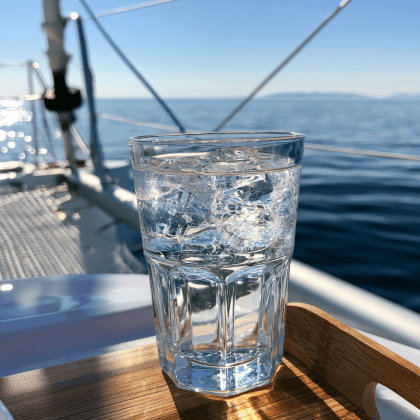
Anyone who has spent a season at anchor knows that fresh water and battery power are the two resources you watch most closely. How much energy your gear pulls from the bank shapes how long you can stay out and how often you need to fire up the engine to top things back up.
Watermakers are a good example of equipment where two units with similar output can have very different appetites for electricity. This article looks at what actually creates that gap, from energy recovery and pump design through to membranes, operating pressure and the way you choose to run the system from one day to the next.
Reverse osmosis works by forcing seawater against a membrane at high pressure so that pure water passes through and the salt is left behind. Most of the seawater that enters the system never becomes drinking water. It leaves as concentrated brine, and in a basic setup that brine exits still carrying nearly all the pressure that was pumped into it. That pressure represents energy, and when it goes overboard unused, the pump has to keep working hard to replace it.
Systems built around an energy recovery design capture that leaving pressure and feed it back into the incoming seawater. Instead of the pump shouldering the full pressure load on its own, the brine helps push the next batch of feed water up toward osmotic pressure. This single feature is the main reason the energy efficiency of a desalination system can vary so widely between models that look almost identical on paper.
The practical result is a much lower amp draw for the same litres per hour. A unit that recovers brine pressure can produce the same volume of water while pulling a fraction of the current a simpler design would need. For a cruiser running off a battery bank rather than shore power, that difference decides whether the watermaker runs comfortably alongside the fridge and autopilot or competes with them.
The high-pressure pump is the heart of any watermaker, and not all pumps convert electricity into pressure with the same grace. Axial piston pumps tend to run efficiently across a range of conditions and waste little energy as heat or vibration. A pump that is well matched to the membranes and built to tight tolerances simply does more useful work for every amp it consumes.
Motor quality matters just as much as the pump. A good motor turns most of the electricity it receives into mechanical work rather than losing it to friction and heat. Cheaper motors and loose drive arrangements bleed away power in ways you never see directly, but you feel them in a faster falling state of charge. This is part of why how much electricity these systems draw is not always obvious from the headline production figure alone.
There is a longevity angle here too. Components that run cool and smooth hold their efficiency over years of service, while parts that run hot and strained tend to drift toward higher consumption as they wear. Choosing a system with well-engineered internals is as much about steady performance over the long haul as it is about the numbers on day one.
Membranes do the actual separation, and their size and quality influence how hard the rest of the system has to push. Generous, efficient membrane area lets a unit hit its target output at a more moderate pressure, which keeps the pump from straining. Undersized or tired membranes force higher pressures to reach the same flow, and higher pressure always means more work for the pump.
Conditions play a role you cannot fully control. Cold water and very salty water both raise the pressure needed to push fresh water through the membrane, so the same machine naturally works a little harder in chilly northern anchorages than in warm tropical seas. Understanding this helps explain why your real-world consumption can shift from one passage to the next.
A system designed with sensible margins handles those swings without a big jump in draw. When the membranes, pump and recovery system are sized to work together, the power demands of producing water onboard stay predictable across the conditions you actually cruise in, rather than spiking whenever the water turns cold or the seas get saltier.
Output and consumption are linked, so matching production to your real needs keeps energy use in check. Running a watermaker to fill exactly what you use, rather than chasing capacity you do not need, is one of the simplest ways to keep the daily draw modest.
Timing helps a great deal as well. Running the unit while the sun is high or the alternator is already turning means much of the energy comes straight from your charging sources instead of your stored reserves. Cruisers with solar or wind often schedule water production around their peak generation hours for exactly this reason.
Finally, smart control rounds it out. Systems that let you manage flow and run steadily at an efficient point, rather than cycling hard, tend to sip power instead of gulping it. Small habits like these add up across a long passage and keep your bank healthier.
The reason some watermakers are gentle on the battery while others are thirsty comes down to a handful of factors working together. Energy recovery is the headline feature, but pump and motor quality, membrane sizing, operating pressure and the way you run the system all shape the final number you see on your monitor.
If you are weighing up an efficient watermaker for your boat and want a clear picture of what it will draw against your particular battery setup, we are happy to help. Reach out to our team for a free quote and we will match a system to your cruising style and energy budget.

Darryl Massey is a seasoned expert in reverse osmosis watermaker technology, with a keen focus on sustainable solutions. With over two decades at EcoSistems, Darryl combines deep technical knowledge and a commitment to innovation, contributing to the development of energy-efficient systems. His expertise ensures advanced, reliable solutions in water purification for clients across the globe.
WATERMAKERS
Sailboat Watermarker
Yacht Watermarker
Boat Watermarker
Reverse Osmosis Watermarker
Watermarker Machine
Marine Watermarker
DESALINATION
Sea water dasalination device
Desalination plant
Reverse osmosis desalination system
Reverse osmosis desalination machine
Reverse osmosis filter
Desalination machine for boat
Reverse osmosis desalination for boats
Desalination machine for sail boat
Desalination machine for yacht
